

142 SelfWork (Second Time Around) Is Depression Simply A Chemical Imbalance? Pt. 1
The SelfWork Podcast
Margaret Robinson Rutherford PhD
4.8 • 1.3K Ratings
🗓️ 24 December 2021
⏱️ 25 minutes
🧾️ Download transcript
Summary
This is our first "Second Time Around" SelfWork episode as we take the holidays off (and I work on Book #2!) I loved this series on the most recent research on depression and what it indicates are the diverse potential sources or "reasons" for someone to experience depression. This was first recorded in 2019 so the information was the newest I could find then... What I will say is that the research I've seen since have been further evidence that depression is NOT simply a chemical imbalance. I'll also reference a recent conversation I had with neuroscientist Dr. Caroline Leaf as to her most recent research and what it shows, as well as another episode that feature the most recent findings in gut research and what it has to do with depression as well! You can click on those links for even more information!
Our listener email today is from someone who actually saw me many years ago, and she asks a question about her marriage and her unhappiness within it, “Does everyone who’s married have an escape plan?”
This episode is sponsored by BetterHelp! You hope you think about starting the new year off with getting another trained perspective of what you might be facing - and why positive change might be eluding you.
Important Links:
Here's the link once again to my new interactive podcast on Fireside Chat! Click here!
BetterHelp, the #1 online therapy provider, has a special offer for you now!
You can hear more about depression and many other topics by listening to my podcast, SelfWork with Dr. Margaret Rutherford. Subscribe to this website and receive her weekly blog posts and podcasts!
If you’d like to join my FaceBook closed group, then click here and answer the membership questions! Welcome!
My new book entitled Perfectly Hidden Depression has arrived and you can order here! Its message is specifically for those with a struggle with strong perfectionism which acts to mask underlying emotional pain. But the many self-help techniques described can be used by everyone who chooses to begin to address emotions long hidden away that are clouding and sabotaging your current life.
And there’s a new way to send me a message! You can record by clicking below and ask your question or make a comment. You’ll have 90 seconds to do so and that time goes quickly. By recording, you’re giving SelfWork (and me) permission to use your voice on the podcast. I’ll look forward to hearing from you!
.
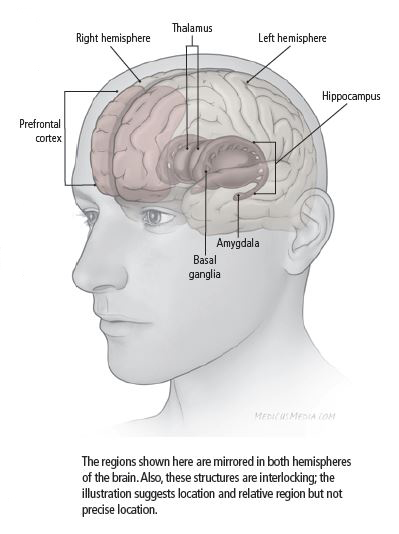
Here’s the graphic from the Harvard article:
Figure 1: Areas of the brain affected by depression
Amygdala: The amygdala is part of the limbic system, a group of structures deep in the brain that’s associated with emotions such as anger, pleasure, sorrow, fear, and sexual arousal. The amygdala is activated when a person recalls emotionally charged memories, such as a frightening situation. Activity in the amygdala is higher when a person is sad or clinically depressed. This increased activity continues even after recovery from depression. Thalamus: The thalamus receives most sensory information and relays it to the appropriate part of the cerebral cortex, which directs high-level functions such as speech, behavioral reactions, movement, thinking, and learning. Some research suggests that bipolar disorder may result from problems in the thalamus, which helps link sensory input to pleasant and unpleasant feelings. Hippocampus: The hippocampus is part of the limbic system and has a central role in processing long-term memory and recollection. Interplay between the hippocampus and the amygdala might account for the adage “once bitten, twice shy.” It is this part of the brain that registers fear when you are confronted by a barking, aggressive dog, and the memory of such an experience may make you wary of dogs you come across later in life. The hippocampus is smaller in some depressed people, and research suggests that ongoing exposure to stress hormone impairs the growth of nerve cells in this part of the brain. |
One more important link:
The Mayo Clinic article on a genetic test to help determine which medications would be best for you.
Our Sponsors: * Check out BetterHelp and use my code betterhelp.com for a great deal: https://www.betterhelp.com Advertising Inquiries: https://redcircle.com/brands
Transcript
Click on a timestamp to play from that location
| 0:00.0 | This is Selfwork, and I'm Dr. Margaret Rutherford. |
| 0:14.1 | At Selfwork, we'll discuss psychological and emotional issues common in today's world |
| 0:19.0 | and what to do about them. |
| 0:20.4 | I'm Dr. Margaret, and Selfwork is a podcast dedicated to you taking just a few minutes today |
| 0:26.2 | for your own Selfwork. |
| 0:29.8 | Hello, and welcome to Selfwork. |
| 0:31.8 | I'm Dr. Margaret Rutherford. |
| 0:33.1 | I'm a clinical psychologist. |
| 0:34.8 | I've lived and worked in fave Arkansas for almost 30 years, and I started Selfwork five |
| 0:40.7 | years ago in order to extend the walls of my practice to those of you who might already |
| 0:45.3 | be very interested in psychological emotional issues. |
| 0:48.6 | Maybe you're in therapy as well, but we enjoy another perspective. |
| 0:52.0 | To the group of you who might just been diagnosed with something and you're looking for answers |
| 0:56.1 | or you're having a relationship issue that you just can't seem to settle or find a |
| 1:01.5 | way through, but also to a third group of you, to those of you who might sit around |
| 1:06.6 | until your friends are that therapy stuff that's for the birds, I'd never do it, but you're |
| 1:11.8 | curious enough or sadly unhappy enough to want to listen to Selfwork. |
| 1:17.2 | So welcome to all of you. |
| 1:20.2 | This is our first second time around Selfwork episode. |
| 1:23.1 | We take the holidays off and I work on book number two. |
| 1:26.8 | I loved this series on the most recent research on depression and what it indicates are the |
| 1:31.4 | diverse potential sources or reasons for someone to experience depression. |
... |
Please login to see the full transcript.
Disclaimer: The podcast and artwork embedded on this page are from Margaret Robinson Rutherford PhD, and are the property of its owner and not affiliated with or endorsed by Tapesearch.
Generated transcripts are the property of Margaret Robinson Rutherford PhD and are distributed freely under the Fair Use doctrine. Transcripts generated by Tapesearch are not guaranteed to be accurate.
Copyright © Tapesearch 2026.