
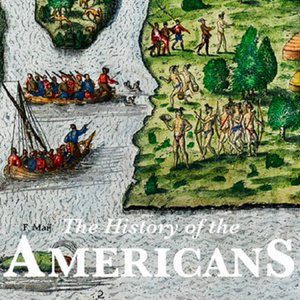
#122 The Founding of Maryland Part 1: Calvert’s Dream
The History of the Americans
Jack Henneman
4.9 • 632 Ratings
🗓️ 15 July 2023
⏱️ 41 minutes
🧾️ Download transcript
Summary
George Calvert had a dream. He had grown up during the most exciting moments of Elizabeth I’s reign, a time when England was transforming from a backwater to a legitimate Atlantic power. He wanted to found a colony in North America.
After a catastrophic attempt in southern Newfoundland, Calvert negotiated a charter from Charles I for a new form of colony – a “proprietary colony,” for which Calvert would be the “Lord Proprietor,” in the northern reaches of the Chesapeake. It would be known as “Mary Land,” and was the largest individual land grant in English North America. The most important provision in the charter, which conferred vast and personal powers on Calvert, was known as the “Bishop of Durham clause,” and dated from English legal precedent of more than 600 years. The roots of American legal traditions are very old.
Sadly for George, he would die even before his charter “passed through seal.” Fortunately for us, his son Cecil would pick up the project and execute it wisely and effectively.
Twitter: @TheHistoryOfTh2
Facebook: The History of the Americans Podcast
Subscribe by email
Selected references for this episode
Matthew Page Andrews, The Founding of Maryland
Wesley Frank Craven, The Southern Colonies in the Seventeenth Century 1607-1689
Bernard C. Steiner, “The Maryland Charter and Early Explorations of That Province,” The Sewanee Review, April 1908.
Transcript
Click on a timestamp to play from that location
| 0:00.0 | Welcome to the History of the Americans podcast, episode 122. |
| 0:11.5 | I'm your host, Jack Heneman, and I'm recording this episode on July 14th, Vive la France, |
| 0:17.8 | 2023, in Austin, Texas. |
| 0:21.9 | We are telling the history of the lands now encompassed by the United States from the beginning without presentism, or at least as little as we can manage. |
| 0:33.5 | Okay, counting by timeline episodes, we've been in early New England for a long time. |
| 0:40.3 | Leaving aside the Memorial Day and Independence Day sidebars, which come to think of it, |
| 0:45.3 | were also located in New England, something like 16 to the last 20 episodes either dealt |
| 0:51.2 | with Puritan New England, Puritans in general, or stuff happening around |
| 0:56.0 | the Puritans. In other words, most of my work and most of you are listening for the first |
| 1:01.1 | half of 2023 has been pretty heavy on theology, and almost entirely in the 1630s. |
| 1:09.4 | We are still spinning around in the 1630s, |
| 1:13.2 | insofar as there are two more colonies to establish |
| 1:17.1 | before we can conclusively break free |
| 1:19.6 | into the sunlit upland meadow of the 1640s. |
| 1:25.0 | The first and the subject of this episode is the prelude to the founding of Maryland in 1634. |
| 1:32.8 | The second is the founding of New Sweden along the banks of the Delaware River in 1638, which |
| 1:38.8 | will get to soon enough. After that, unless my muse dictates otherwise, we will return to Virginia for |
| 1:47.1 | Opa Cancanaugh's third and final war on the English. We have, in fact, already touched |
| 1:54.1 | upon Maryland's early days back in mid-April, episode 112, as Apple reckons it, it and 115 if you listen on the website that time |
| 2:04.2 | Maryland and Virginia went to war obsessed as I am with chronology I should have done this episode |
| 2:11.5 | even before that one and certainly before the episodes on Roger Williams the Pequot War and Ann |
| 2:17.2 | Hutchinson but I didn't have the books I wanted to do the job properly. |
... |
Please login to see the full transcript.
Disclaimer: The podcast and artwork embedded on this page are from Jack Henneman, and are the property of its owner and not affiliated with or endorsed by Tapesearch.
Generated transcripts are the property of Jack Henneman and are distributed freely under the Fair Use doctrine. Transcripts generated by Tapesearch are not guaranteed to be accurate.
Copyright © Tapesearch 2026.