
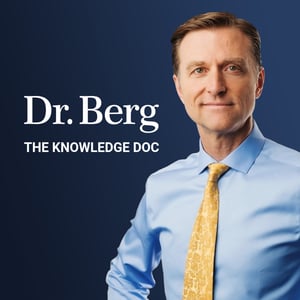
#1 Best Meal to Prevent a Heart Attack and Stroke
Dr. Berg’s Healthy Keto and Intermittent Fasting Podcast
Dr. Eric Berg
4.7 • 1.7K Ratings
🗓️ 16 October 2025
⏱️ 12 minutes
🧾️ Download transcript
Summary
The best meal to prevent a heart attack or stroke will also help clean your arteries! Support cardiovascular health naturally by consuming the top foods for stroke and heart attack prevention that also help prevent blocked arteries.
Did you know that clots cause 80%-90% of heart attacks and 87%-91% of strokes? This is why the top foods for stroke and heart attack prevention also help clean your arteries.
Typically, when a clot forms, it dissolves within minutes or hours. This is a normal survival mechanism and does not cause heart attacks or strokes. When the normal clotting process becomes dysfunctional, you can develop blocked arteries.
Dysfunctional clotting typically starts from a leak in your gums or gut when endotoxins enter the body. Excess iron can contribute to the problem. Pathogens need iron to survive. Excessive free iron can feed and amplify endotoxins, thereby awakening dormant pathogenic microbes.
Excess iron typically comes from fortified foods, such as bread, pasta, cereal, and ultra-processed carbs. If you need iron, it's best to get it from red meat rather than a supplement. Stress increases adrenaline, which can amplify the effects of pathogens and cause them to consume more iron.
Disclaimer: Dr. Eric Berg received his Doctor of Chiropractic degree from Palmer College of Chiropractic in 1988. His use of “doctor” or “Dr.” in relation to himself solely refers to that degree. Dr. Berg is a licensed chiropractor in Virginia, California, and Louisiana, but he no longer practices chiropractic in any state and does not see patients, so he can focus on educating people as a full-time activity, yet he maintains an active license. This video is for general informational purposes only. It should not be used to self-diagnose, and it is not a substitute for a medical exam, cure, treatment, diagnosis, prescription, or recommendation. It does not create a doctor-patient relationship between Dr. Berg and you. You should not make any change in your health regimen or diet before first consulting a physician and obtaining a medical exam, diagnosis, and recommendation. Always seek the advice of a physician or other qualified health provider with any questions you may have regarding a medical condition.
Transcript
Click on a timestamp to play from that location
| 0:00.0 | Today we're going to talk about the absolute number one best meal to prevent heart attacks |
| 0:05.4 | and a stroke. There's something very unique about heart attacks and strokes. |
| 0:12.1 | 80 to 90 percent of heart attacks are clots. Now you might think like this plaque that builds up, |
| 0:18.8 | no, most of heart attacks come from clots. And 87 to 91% of |
| 0:24.5 | strokes also come from clots. And the meal we're going to talk about today really has to do with |
| 0:30.2 | preventing these clots. And this information today is based on the works from Professor Douglas |
| 0:36.4 | Kell. Genius. I will put a link down below, |
| 0:39.9 | referencing some of his information, but he's stumbled on something very fascinating relating to |
| 0:46.1 | dormant microbes. And a lot of these dormant microbes are actually pathogenic. They create |
| 0:52.9 | disease. But they're asleep and they're waiting for an |
| 0:55.9 | opportunity to come back alive. I mean, even in the winter, for example, you have all these |
| 1:00.4 | microbes in the soil that become frozen, but they're going into this dormant mode or a spore mode, |
| 1:06.2 | and they're waiting until the season to change where they can come out and thrive. So this is what you need |
| 1:12.9 | to know. Normally when a clot forms, whether you cut yourself on your finger or something |
| 1:20.9 | happens internally, you have certain things that come in there, certain proteins that form a clot, |
| 1:26.9 | and then right |
| 1:27.7 | after that once it heals it dissolves sometimes within minutes sometimes |
| 1:32.9 | hours sometimes a little bit longer this is a normal clotting process if we |
| 1:37.5 | didn't have this survival mechanism we would bleed to death however in certain |
| 1:42.0 | circumstances especially with heart attacks and strokes, we have a different |
| 1:47.9 | type of clotting that occurs. |
| 1:49.8 | Now we have dense, matted strings of spaghetti that get hardened that are very difficult to dissolve. |
... |
Please login to see the full transcript.
Disclaimer: The podcast and artwork embedded on this page are from Dr. Eric Berg, and are the property of its owner and not affiliated with or endorsed by Tapesearch.
Generated transcripts are the property of Dr. Eric Berg and are distributed freely under the Fair Use doctrine. Transcripts generated by Tapesearch are not guaranteed to be accurate.
Copyright © Tapesearch 2026.