
What People Who Choose Assisted Death Actually Say
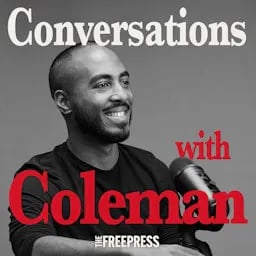
Conversations with Coleman
The Free Press
4.8 • 2K Ratings
🗓️ 26 May 2026
⏱️ 61 minutes
🧾️ Download transcript
Summary
Transcript
Click on a timestamp to play from that location
| 0:00.0 | Welcome to another episode of Conversations with Coleman. My guest today is Rupa Subramanya. |
| 0:06.2 | Rupa is a writer for the free press who focuses on Canada. She has a weekly column aptly titled |
| 0:12.1 | This Week in Canada. In this episode, we talk about Canada's assisted dying law, known as |
| 0:18.5 | Maid, which stands for medical assistance in dying. We talk about how a law |
| 0:23.2 | originally intended for people with terminal illness has expanded to include lots of people with |
| 0:29.0 | serious but not terminal ailments. We also talk about the ethics and tradeoffs involved in |
| 0:35.4 | assisted dying laws in general. So without further ado, |
| 0:39.2 | Rupa Subramanya. |
| 0:45.1 | I want to tell you about a podcast I think you're going to appreciate. It's called |
| 0:51.1 | Unpacking Israeli History. If you follow the news about Israel, you're just getting |
| 0:55.7 | headlines. But headlines are just a tiny slice of a long, complicated, and genuinely fascinating |
| 1:02.6 | story. One of the things I care about on this show is engaging seriously with complexity, |
| 1:07.5 | rather than flattening it. That's exactly what host Dr. Noam Weissman does on |
| 1:12.1 | unpacking Israeli history. He dives deep into the events, the people, and the moments that |
| 1:17.7 | shaped Israel past and present, with genuine empathy and a willingness to explore multiple |
| 1:22.6 | perspectives. And when he brings in guests like philosopher Micah Goodman or journalist |
| 1:27.3 | Havivretettig Gore, |
| 1:28.4 | they add real depth to the conversation. |
| 1:31.5 | It's deeply researched storytelling for people who want to understand Israel rather than just |
| 1:35.8 | confirm what they already think. |
| 1:37.9 | In today's climate, that's rare and it matters. |
| 1:41.4 | Find unpacking Israeli history on your favorite podcast app or YouTube and |
... |
Transcript will be available on the free plan in 15 days. Upgrade to see the full transcript now.
Disclaimer: The podcast and artwork embedded on this page are from The Free Press, and are the property of its owner and not affiliated with or endorsed by Tapesearch.
Generated transcripts are the property of The Free Press and are distributed freely under the Fair Use doctrine. Transcripts generated by Tapesearch are not guaranteed to be accurate.
Copyright © Tapesearch 2026.