
Underdog Innovation w/Joe Lonsdale
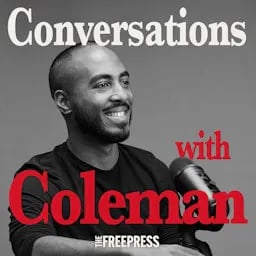
Conversations with Coleman
The Free Press
4.5 • 619 Ratings
🗓️ 27 March 2025
⏱️ 52 minutes
🧾️ Download transcript
Summary
Transcript
Click on a timestamp to play from that location
| 0:00.0 | The |
| 0:07.0 | The All right, Joe Lonsdale, thanks so much for doing this. |
| 0:32.0 | Thanks for having me. |
| 0:33.0 | I'm excited to be here at our university. |
| 0:35.0 | Okay, so we were actually, we were just chatting about chess |
| 0:37.8 | before we started. |
| 0:39.0 | And you share something in common with one of my favorite people |
| 0:43.7 | and one of my mentors, Tyler Cowan, |
| 0:45.5 | which is that you were extremely good at chess as a child |
| 0:49.4 | and obsessed with it. |
| 0:51.5 | And as an adult, you've gone on to do other things. |
| 0:56.0 | You know, Cowan, he, I think he was state chess championship of my home state, New Jersey at 15, |
| 1:02.0 | and then one day he just realized, actually, I don't want to do this for a living. |
| 1:06.0 | My chess master, as I was a kid, used to tell me that most great men were chess players, but a few chess players are ever great men. So, you know, probably don't want to do it like your whole life. But, but I think it's really good for your mind. Why? There's a lot of things. It's like this intellectual discipline. It's like trading your brain to like to think ahead and stop every time you do something and then think about all the next steps and how they might interact and then there's probably like trades you to have a stronger memory because to really do it right you have to memorize a lot of old games and then there's also just like just like as a kid you have to really spend like 20 30 hours a week at least to be really good at it so to work that hard on something like one of my lessons in general is you can't really be great by being a dilettante. If you want to be great, you have to like really focus on something for a long period of time. That's what entrepreneurship is. That's what great scholarship is. I'm not, unfortunately, a great writer. I haven't written any great books, but it seems like that would be the necessary thing there too. So that lesson of the focus, like no matter how smart you are, I can play the smartest person in the world. I still crushed them if they hadn't put in those hundreds of hours of work. So it is something that just teaches you how to work hard and trains your brain. Yeah, I agree with that. I think I learned that being obsessed with playing trombone as a kid, as silly as it sounds. It almost doesn't matter what the skill is, but learning what it takes to get great at something by example, I think is important because it just tells you how much work you actually have to do in order to reach the top five or one percentile at a skill, which is really what you need to do in order to be great. |
| 2:37.0 | It's really annoying. It'd be great if you could just do it right away. |
| 2:39.0 | Yeah. |
| 2:40.0 | One thing that strikes me about chess is that especially classical games, long games, |
| 2:48.0 | it rewards intense analysis before you make a decision, right? |
| 2:52.9 | Like you need to calculate, make sure that the move you're about to play is extremely |
| 2:58.4 | solid before you act. |
| 3:00.7 | And it strikes me that that might not actually be the best strategy, say as a business |
| 3:06.3 | person, where time is incredibly precious and valuable. |
... |
Please login to see the full transcript.
Disclaimer: The podcast and artwork embedded on this page are from The Free Press, and are the property of its owner and not affiliated with or endorsed by Tapesearch.
Generated transcripts are the property of The Free Press and are distributed freely under the Fair Use doctrine. Transcripts generated by Tapesearch are not guaranteed to be accurate.
Copyright © Tapesearch 2026.