
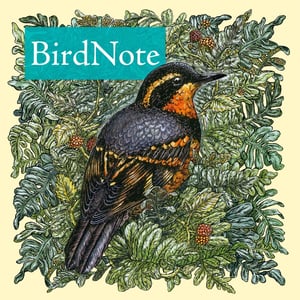
The Cardinal: A Southerner Moves North
BirdNote Daily
BirdNote
4.8 • 1.3K Ratings
🗓️ 18 December 2021
⏱️ 2 minutes
🧾️ Download transcript
Summary
Transcript
Click on a timestamp to play from that location
| 0:00.0 | This is bird note. |
| 0:02.0 | Holiday cards often feature gorgeous red cardinals against a snowy landscape. |
| 0:10.0 | So it's easy to assume the birds have always been a colorful presence in bleak northern |
| 0:15.4 | winters. But Cardinals used to be southern birds. In fact, they were rarely seen north of Pennsylvania. |
| 0:21.6 | By the second half of the 20th century, though, |
| 0:24.6 | they were being spotted year round throughout New York. |
| 0:27.5 | And they were nesting as far north as Maine, |
| 0:29.9 | the Northern Midwest, and even Southern Canada. |
| 0:35.0 | There are three key reasons for the Cardinal's Northern March. |
| 0:39.0 | Rising temperatures have reduced snowfall |
| 0:41.0 | so Cardinals can continue to forage for food on the ground during winter months. |
| 0:44.8 | Then there's human development. Cardinals are drawn to suburban habitat, so as people convert forests |
| 0:51.0 | and prairies to cul-de-sacs, the birds soon follow. |
| 0:55.2 | And finally, backyard bird feeders. |
| 0:58.0 | By supplying birdseed, we humans help Cardinals survive the harsh winters of higher latitudes. |
| 1:03.5 | By the 1980s, as if to fully cement the bird's new turf, |
| 1:07.1 | its official name was changed from just Cardinal to Northern Cardinal. |
| 1:11.8 | But the southeastern states, topped by Louisiana, still have the most Cardinals per acre. |
| 1:17.0 | The Redbird, as southerners call it, will always be a southerner. Today's show brought to you by the Bobbbleink Foundation. |
| 1:28.6 | For Bird Note, I'm Mary McCann. |
Please login to see the full transcript.
Disclaimer: The podcast and artwork embedded on this page are from BirdNote, and are the property of its owner and not affiliated with or endorsed by Tapesearch.
Generated transcripts are the property of BirdNote and are distributed freely under the Fair Use doctrine. Transcripts generated by Tapesearch are not guaranteed to be accurate.
Copyright © Tapesearch 2026.