
LAST SHOT IN ANGER: 6/8: Lincoln's Peace: The Struggle to End the American Civil War Hardcover – Illustrated, March 18, 2025 by Michael Vorenberg
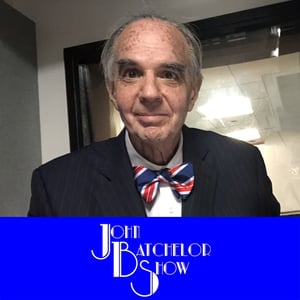
The John Batchelor Show
John Batchelor
4.5 • 2.8K Ratings
🗓️ 28 June 2025
⏱️ 8 minutes
🧾️ Download transcript
Summary
by Michael Vorenberg
1865 BROADWAY LANDING APPOMATOX VA
https://www.amazon.com/Lincolns-Peace-Struggle-American-Civil/dp/1524733172
We set out on the James River, March 25, 1865, aboard the paddle steamboat River Queen. President Lincoln is on his way to General Grant’s headquarters at City Point, Virginia, and he’s decided he won’t return to Washington until he’s witnessed, or perhaps even orchestrated, the end of the Civil War. Now, it turns out, more than a century and a half later, historians are still searching for that end.
Was it April 9, at Appomattox, as conventional wisdom holds, where Lee surrendered to Grant in Wilmer McLean’s parlor? Or was it ten weeks afterward, in Galveston, where a federal commander proclaimed Juneteenth the end of slavery? Or perhaps in August of 1866, when President Andrew Johnson simply declared “the insurrection is at an end”? That the answer was elusive was baffling even to a historian of the stature of Michael Vorenberg, whose work served as a key source of Steven Spielberg’s Lincoln. Vorenbergwas inspired to write this groundbreaking book, finding its title in the peace Lincoln hoped for but could not make before his assassination. A peace that required not one but many endings, as Vorenberg reveals in these pages, the most important of which came well more than a year after Lincoln’s untimely death.
To say how a war ends is to suggest how it should be remembered, and Vorenberg’s search is not just for the Civil War’s endpoint but for its true nature and legacy, so essential to the American identity. It’s also a quest, in our age of “forever wars,” to understand whether the United States's interminable conflicts of the current era have a precedent in the Civil War—and whether, in a sense, wars ever end at all, or merely wax and wane.
Transcript
Click on a timestamp to play from that location
| 0:00.0 | This is CBSI in the world. I'm John Bachelor with Michael Vorenberg. His book is Lincoln's Peace, |
| 0:09.8 | The Struggle to End the American Civil War. We're in Congress now. The battles that are important |
| 0:15.0 | require us to understand the personality and the transformation and the disappointment in the president, Andrew Johnson. |
| 0:23.9 | What do we need to know about him between Lincoln's assassination and early 1866? |
| 0:32.3 | Well, let me step back to this moment of Richard Henry Dana giving his grasp of war speech in the summer of 1865, |
| 0:40.8 | that philosophical stance that the United States is still able to use war powers, that it's still in a state of war, |
| 0:49.1 | even if the organized armies have stopped fighting each other, that is the basis under which Congress will start to frame |
| 0:57.2 | reconstruction legislation when it comes into session in December of 1865. And as you say, starts to make |
| 1:04.0 | laws that are crucial to reconstruction. There are two laws that are most important. One is the |
| 1:10.1 | renewal or the creation as the renewal of the Friedman's Bureau Act, or if you want to call it the creation of the Second Freedmen's Bureau Act, either way. And the second is the Civil Rights Act, which will become known as the Civil Rights Act of 1866. The Freedmen's Bureau Act is passed under the War Powers Act. |
| 1:30.4 | And so that's very much on the minds. |
| 1:32.1 | This is the second one. |
| 1:34.6 | The first one had been passed under Lincoln's presidency. |
| 1:38.0 | So you could hardly say that Lincoln would not have approved. |
| 1:44.6 | There is some debate about what the new one will do and what justifies its existence. |
| 1:47.2 | So this is the agenda of Congress. |
| 1:57.1 | When Andrew Johnson became president in April of 1865, the very members of Congress who are most interested in a strong reconstruction program, they looked at Johnson as their ally, which |
| 2:03.3 | strikes us as very odd today because we know that they would become enemies. |
| 2:09.3 | But Johnson comes into power with very strong talk about how, as I mentioned, traders are to be |
| 2:17.3 | punished and treasoned to be made odious. |
| 2:19.3 | It sounds like he's going to back whatever Congress does to make sure that the Confederacy |
| 2:25.6 | can never rise again. |
... |
Please login to see the full transcript.
Disclaimer: The podcast and artwork embedded on this page are from John Batchelor, and are the property of its owner and not affiliated with or endorsed by Tapesearch.
Generated transcripts are the property of John Batchelor and are distributed freely under the Fair Use doctrine. Transcripts generated by Tapesearch are not guaranteed to be accurate.
Copyright © Tapesearch 2026.